

The Sacred Guardians of Fairness
Eddie Edwards
Contributing Editor, Sham Illustrated
Ah, the golf handicap committee — that noble band of unpaid heroes who selflessly patrol the fairways to ensure that the spirit of fair play lives on. While the rest of us are content to accept the imperfections of golf, they see themselves as its protectors.
If you are willing to acknowledge that handicaps allow golfers of varying abilities to compete against each other fairly then the handicap committee will unquestionably be your best line of defense against the sandbaggers.
You know who I’m talking about. The players who post handicaps based on the eighty-sevens they shoot in the Wednesday morning game, then produce suspiciously crisp seventy-eights in the member-guest.
Handicappers will categorize this kind of randomness as an unusual scoring pattern. The rest of us will call it cheating, and that’s part of the problem. These committees are generating terminology that sounds like it was written by meteorologists, which doesn’t exactly instill confidence.
A friend of mine told me he received a letter from the committee at his club indicating that his handicap would be adjusted due to injury. He wasn’t sure if this was in relation to the number of people hit or the extent of property damage.
All the same, without the committee’s watchful eye, sandbaggers will continue to run rampant, destabilizing the very foundation of the golfing universe and, more importantly, ruining your chances of winning the Ladies Auxiliary of the Sons of Slow Play charity scramble.
Frankly, I’m not sure why there is so much talk about fairness in golf. There is nothing fair about golf. In a typical round, a golfer will be confronted with an intimidating number of obstacles including the rules of golf, which are almost as complicated as trying to calculate a handicap index.
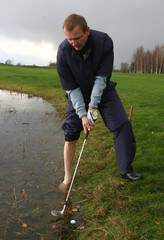
There will also be sand traps, water hazards, waste bunkers, houses, swimming pools and school buses. Not to mention the laws of physics. Golf balls are round, but clubs are flat, which means your shots might bounce off squirrels, but not water. No number of strokes is ever going to help golfers facing these kinds of discriminations.
Let’s be honest. Do we really need a committee policing our score cards like they were evidence from a crime scene? Golf is the only sport I know where it takes more governing bodies than players to determine whether or not your ball might be affected by a loose impediment. Next time someone tells you golf is a simple game, ask them if they’ve turned in all of their scores.
And yet, for all the whispered accusations, raised eyebrows, and occassional intimidation, we do appreciate what they do. Who else could so succinctly remind us that golf isn’t just a frustrating game, but an ideology.
So, here’s to you, oh sentinels of the tee sheets. May your algorithms remain inscrutable, your spreadsheets forever conditionally-formatted, and your patience for “I just had a bad day” excuses eternal. Without you, golf would still be fun — but dangerously unregulated fun. And that cannot be allowed.
Eddie Edwards has followed the GSTPA Tour for nearly four decades. His work documents the effect of prolonged exposure to golf on participants and observers.
Research Note
- Repeated failure continues to be misclassified as progress.
Internal Notice
- No Administrative Response Planned.

From the Field
- Findings delayed pending emotional recovery.

These materials reflect field notes, behavioral observations, and informal conclusions derived from prolonged exposure to golfers and golf culture. Views expressed by contributors are their own and do not necessarily reflect the official position of the GSTPA, the GSTPA Tour, or Sham Golf Media LLC.